
'The Kashmiri wants freedom, the dignity that comes from it and the intellectual versatility that flows from the combination of the two,' says political historian Siddiq Wahid.

'Just how strong were the ties between the world's largest and oldest democracies that an incident involving a diplomat and a maid led to anger threatening the relationship itself? Or had the relationship been weakening in the past few years, masked by the empty symbolism of State dinners, asks Devesh Kapur.

'On June 15, 1965, Major A K Afridi of the Pakistan army was captured by Papa's 1 Mahar unit near Vigokot, when he accidently walked into Indian territory.' 'While he was being airlifted to Delhi from Kutch, Major Afridi made a request: He wanted to watch Sangam>, the movie starring Raj Kapoor and Vyjayantimala. It was a request that the Indian Army fulfilled.' 'Major Afridi was sent with armed escorts to watch the movie in Ahmedabad and then sent to Delhi for further interrogation.'

Specially abled Sai Kaustuv Dasgupta talks about how he wants to make his life a message to all the 'wheelchair warriors'.

'No PM has said no to anything we have proposed. I am not a politician and I cannot give speeches about things, but a lot of good things have been done in science by previous governments.' 'Under Dr Manmohan Singh, we could do a few important things. I used to meet him once in 6, 8 weeks. He often said, 'Professor Rao, you assume that you have my approval and carry on.' He was shy and decent. He is a real gentleman.' 'Science keeps me going at 80. I feel young.' Professor C N R Rao, the eminent scientist who was honoured with the Bharat Ratna, on the state of science in India.
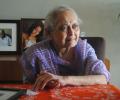
Sheela Bhatt meets Bharti Patel, a truly exceptional mother of our times whose son Dr Vikram Patel was recently ranked among Time magazine's 100 most influential people of 2015, to find out her recipe for a remarkable upbringing.

'The question now is how long the exercise in perfection he created will last once his influence isn't there any longer,' says Sunanda K Datta-Ray.

'Indian politics has had three-and-a-half master narratives -- secular nationalism, Hindu nationalism, justice for lower castes and regionalism. The AAP seeks to go beyond that. Therein lies its promise and its challenge,' says Ashutosh Varshney, Brown University professor and author of book Battles Half Won, India's Improbable Democracy.

This is the full text of Prime Minister Manmohan Singh's address to media persons ahead of his interaction with them in New Delhi on Friday

From starting with two sewing machines in her bedroom, Anita Dongre is all set to launch two stores in America. Archana Masih meets the designer for the working woman and the bride.
.jpg)
Ayurvedic expert Dr G G Gangadharan on how the ancient Indian medical practice needs to be propagated in the country of its origin

'It is in the interest of both sides that the visit of the US President is seen as being successful. Both sides have invested considerable political capital in it. This rapid exchange of visits and the decisions taken have to be justified, beyond the symbolism, which is no doubt important in itself. This opportunity to impart a fresh momentum to ties should not be missed,' says former foreign secretary Kanwal Sibal.

Here's your weekly dose of weird, true and funny news from around the world.

Winners of the 2016 National Geographic Nature Photographer of the Year.

'When he first came to office, my belief is that the PM's reading of the landscape was that, with a vanquished Congress and fragmented Opposition, he was looking at least at two terms in office. This reading perhaps allows for a more cautious, gradual approach.' 'It was only a matter of time before the government was forced to come face-to-face with a serious corruption scandal. This is not a commentary on the BJP, but a statement about India's political economy.' 'There is growing concern about the government's commitment to freedom of expression, religious tolerance, and an independent civil society. Thus far, the positive movement on strategic and economic matters has crowded out these concerns, but they are lingering beneath the surface.'

'If, as appears to be the case, India is on way to 'mending fences' with China, and China is equally desirous to 'reset' the relationship, this could be a self-reflexive moment in India's positioning vis-a-vis not just the Dalai Lama, but also the Tibetan issue and China as a whole,' points out China expert Alka Acharya.

'The unique achievements have been made by engineers from small towns who have had a non elite upbringing and who have grown with the programme,' says R Aravamudan, one of the pioneers of the Indian space programme.

'We have been found seriously wanting in addressing our undersea warfare capability and China's emergence is a cause for concern.'

Samuel Stokes made India his home and participated in the freedom struggle. He was the only American to be imprisoned for sedition; the British CID maintained a special file on him.

We bring you this excerpt from Shaili Chopra's book, When I was 25.

'The voter thinks that the State is not going to impartially deliver services, provide justice, basic law and order, social insurance -- so as a voter it's very rational that I may choose a criminal who will help me navigate the State.' 'A weak State allows a criminal politician to be the person who provides that guarantee to mediate whatever problem the citizen has with the State.'

It emerges that not only does the CIDR project fails the test of fairness, justness and reasonableness besides the test of not being fanciful, oppressive or arbitrary; it also fails the test of Arthashastra, Hadith and the Bible.
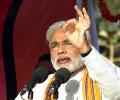
The kind of people Narendra Modi has chosen, the decisions he has taken and the rail and central budgets suggests that he is treading carefully in New Delhi. There is less of innovation and more of continuity, so far. He is not ready to rock the boat and start from scratch, says Sheela Bhatt.

The year 2014 is coming to an end. It was the year of conflict, the year of strife. Year 2014 will be remembered for several reasons -- the rise and threat of the Islamic State, the downing of two Malayasia Airlines aircraft and the sudden and effective way of using hastags on social media to generate a buzz about the event. After all, who can forget #theicebucket challenge and the phenomenon it grew into. Read on as we bring you an overview of international news and events of 2014.

To mark his 50th death anniversary, rediff.com has launched a special series to evaluate Jawaharlal Nehru's legacy.

How India can defend itself in the war against superbugs.
The BJP government is no better than the Congress -- as wretched and anti-people. In addition, it is explicitly and aggressively communal, says Venkatesh B Athreya, in a hard-hitting interview to Shobha Warrier/Rediff.com.

How can 'first food' meet the challenge posed by factory-made 'fast foods' which are backed by marketing money and often come with 'traditional taste' tags attached to them? The first step would be to preserve knowledge about first foods, says Dinesh C Sharma.

Desis in the US recall their earliest celebration of the festival of lights on American soil. Chaya Babu reports

Only three percent of Indians pay income tax; our tax-GDP ratio is among the lowest in the world. This must change. Our elites must realise that India's poverty has damaging consequences for them, and that they can help decrease it. The food security bill, with all its limitations, will hopefully contribute to generating such awareness, says Praful Bidwai.

'America's withdrawal from Vietnam was an inspiring moment for all of us. We believed that it was a glorious victory of ideology and spirit and as historic as the defeat of the Nazis exactly 30 years ago,' remembers Kumar Ketkar 40 years after the end of the Vietnam War.

'The fragility of this case is that taking a side could be a fallacy to do. Because you don't have all the answers. So how do you take one particular side?' Meghna Gulzar asks Vaihayasi Pande Daniel/Rediff.com

Prime Minister Narendra Modi, who recently completed one year in office, has, in an exclusive interview with Smita Prakash, editor, ANI, said the opposition alleging that his government is a "suit boot ki sarkar" is definitely better and more acceptable than being labelled a "suitcase" (ki sarkar), and satirically added, that after ruling for sixty years, the Congress has suddenly remembered the poor.

Few Harvard graduates are changing the way we teach students.

Prime Minister Narendra Modi gave the vote of thanks to the President's speech on the opening day of the Budget session.

'You want a steady, confident, self-assured and highly skilful hand at the till. 'It is a pity that the BJP has decided to deprive itself of such a hand at this politically sensitive time.' 'It is like sacking your surgeon in the middle of your brain surgery,' says S Muralidharan.

Bollywood's Badshah turns 50 on November 2, and it's time to celebrate his life and movies.

Pranjul Bhandari, Chief India Economist, HSBC, speaks about a range of issues ranging from inflation, to how Goods and Services Tax and land acquisition bills can help India hit double digit growth, and her impressions about economic growth in the last one year after Narendra Modi took over as India's Prime Minister.
